Iconic Brand Guidelines And Logo Manuals From 60S 70S And 80S
A Trip Down Memory Lane: Iconic Brand Guidelines from the Golden Eras of Branding Remember those days? The 60s, 70s, and 80s – a vibrant tapestry of cultural shifts, technological leaps, and, crucially for us at Brandkity, a burgeoning era of sophisticated branding. While digital tools and cloud-based platforms have revolutionized how we manage our
Table of contents
- A Trip Down Memory Lane: Iconic Brand Guidelines from the Golden Eras of Branding
- Nasa
- Apple
- 1972 Munich Olympics
- 1980 Moscow Olympics
- Next
- New York City Transit Authority
- Deutsche Bank
- IBM
- The Dawn of Formalized Branding: The 1960s
- The Era of Boldness and Expansion: The 1970s
- The Age of Personal Computers and Global Brands: The 1980s
- The Enduring Legacy of Analog Guidelines
- From Print to Pixels: The Evolution of Brand Asset Management
- The Digital Revolution and Brandkity’s Role
- Looking Ahead: The Future of Brand Guidelines
A Trip Down Memory Lane: Iconic Brand Guidelines from the Golden Eras of Branding
Remember those days? The 60s, 70s, and 80s – a vibrant tapestry of cultural shifts, technological leaps, and, crucially for us at Brandkity, a burgeoning era of sophisticated branding. While digital tools and cloud-based platforms have revolutionized how we manage our brand assets today, there’s immense value in looking back at the foundational principles laid down in those iconic eras. These weren’t just pamphlets; they were meticulously crafted blueprints for brand identity, often printed on high-quality paper, treated with the reverence they deserved. Let’s take a walk through some of the most memorable brand guidelines and logo manuals from these transformative decades.
Some of the examples below were published as a book years later. I’ve included links for the graphic design junkies who need these in their bookshelves.
Nasa
Year: 1975, Author: Danne & Blackburn
The NASA Graphics Standards Manual by Richard Danne and Bruce Blackburn was a futuristic vision for the National aeronautics and space administration. Known as the NASA logotype, and nicknamed the ‘worm’, it was introduced in 1975 in an attempt to introduce a touch of modernity by replacing NASA’s circular blue, white and red insignia (aka the ‘meatball’).
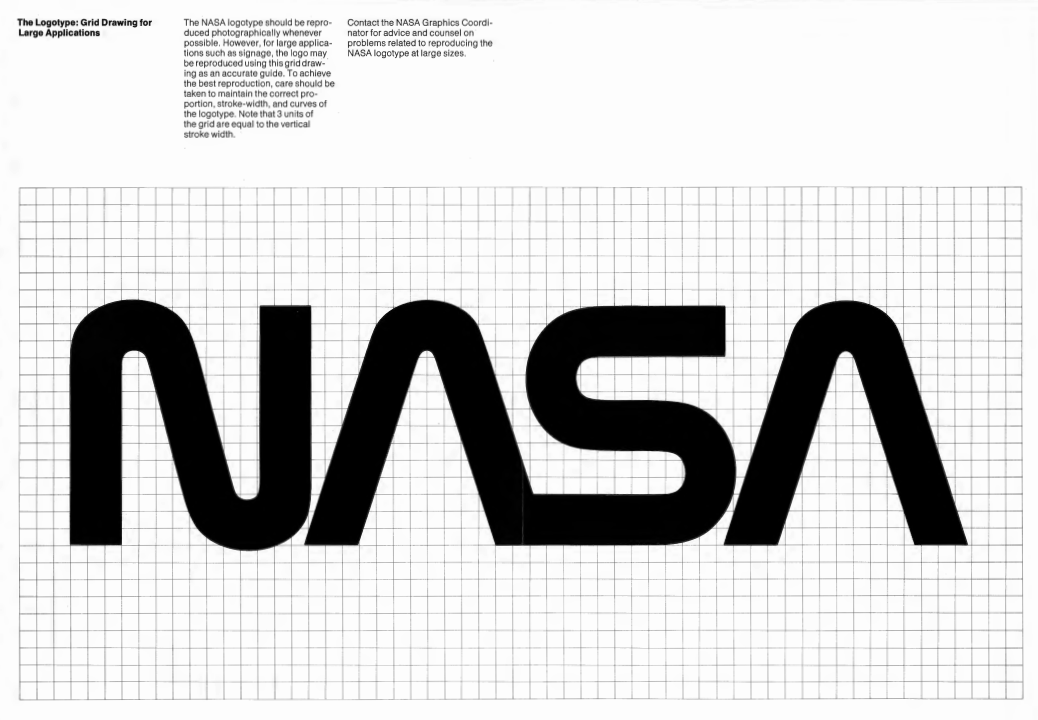
The manual goes into incredible detail in terms of the physical applications. It’s probably one of the few to include logo placement rules for a t-shirt as well as the space shuttle.
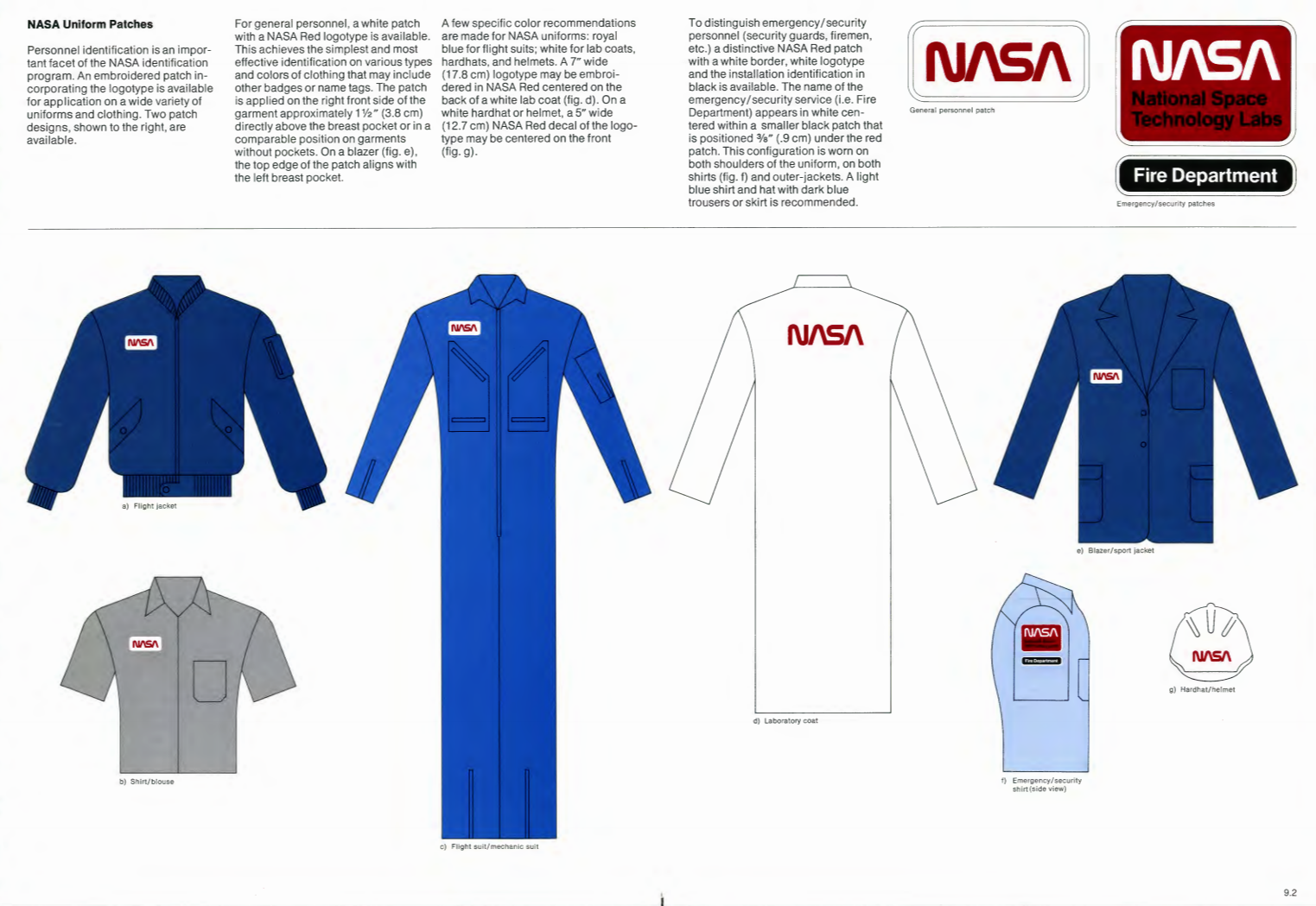
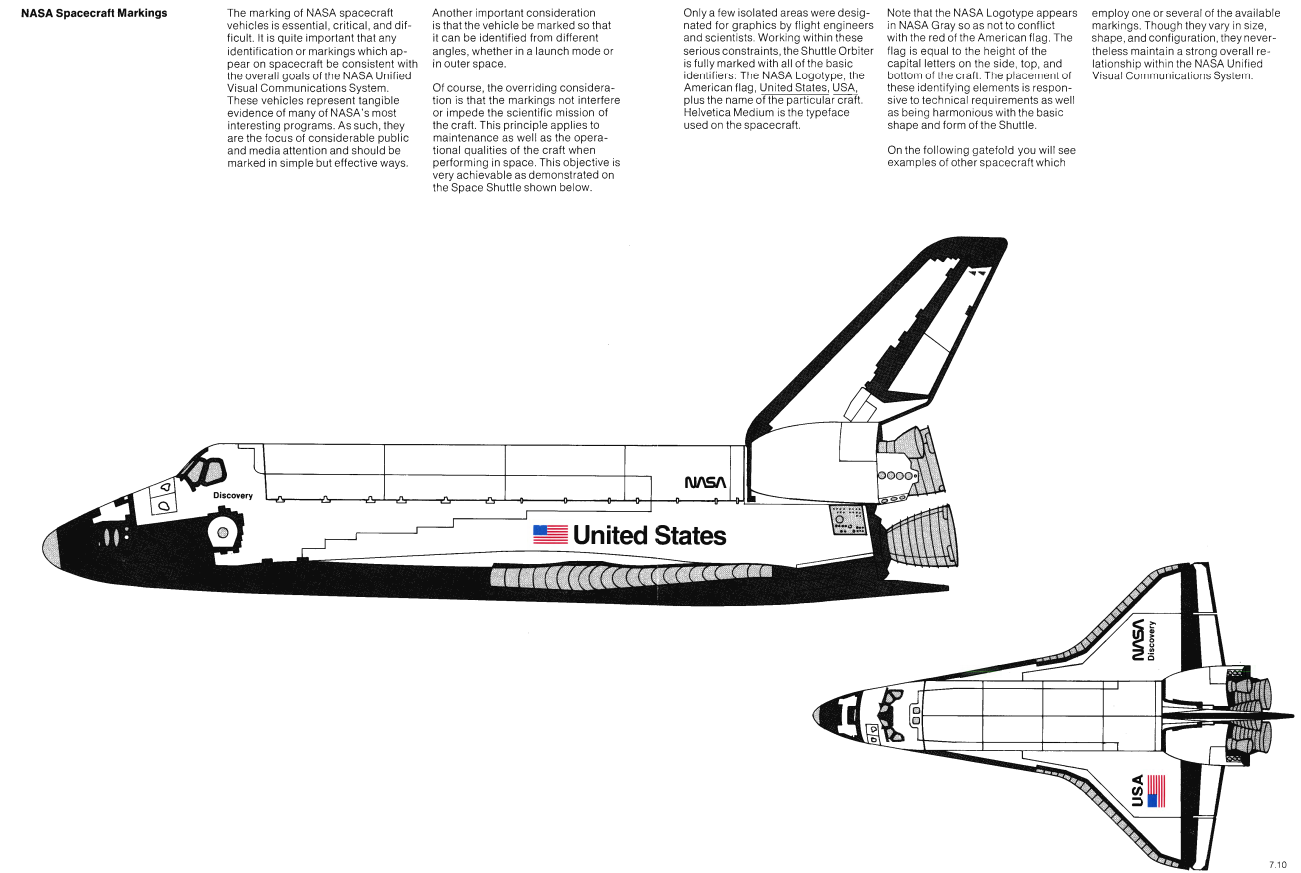
You can see the full manual in pdf or order a hardcover copy for $79.00.
Apple
Year: 1977, Author: Rob Janoff
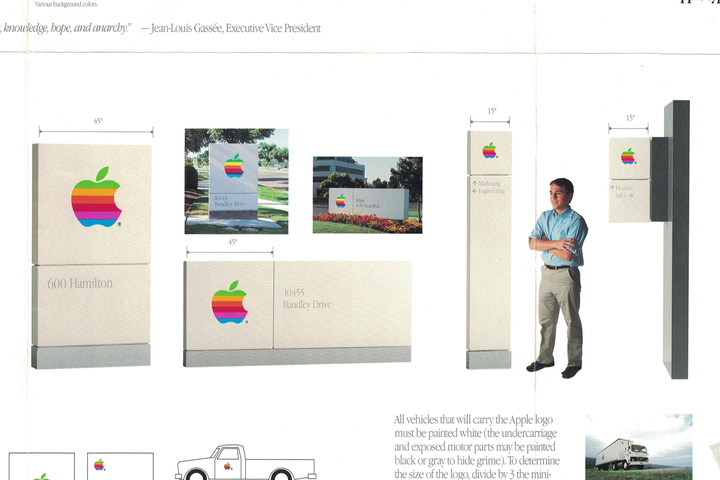
The original version of the Apple logo was designed by Rob Janoff in 1977. Rocking the playful rainbow colors and serif font, it’s quite far from the sleek cold look Apple adopted since. When searching for the brand guidelines document I was surprised it’s actually quite plain. It contains all the definitions for spacing, colors and typography but that’s about it.
However I came across this blog post which featured a foldable poster full of details about the Apple brand and its applications. It’s also really well written so be sure to check it out.

1972 Munich Olympics
Year: 1967, Author: Otto Aicher
In 1967 Aicher was commissioned to create a playful image for first Olympic games organized in Germany since the World war II. Inspired by the Bauhaus movement and its focus on use rather than aesthetics his work has set a new standards for branding and corporate design.
The brand guidelines contained a flexible system of colors, fonts and forms. That allowed Aicher’s team and partners to build to “play freely” and saved “unnecessary preparatory work and time-consuming detailed decisions”. Something that we now simply call a design system was quite a groundbreaking idea in 1967.

Sadly there is no complete digital version of this manual online. You can however buy it for $78.00.
1980 Moscow Olympics
Year: 1980, Author: Vladimir Arsentyev
Another example of a visual design guidelines for Olympic games. Just like Germany in 1972, Russia also needed to present itself as a modern forward looking country. Artistic freedom had to give to the state politics.

What caught my attention much more than the logo itself were these geometric icons for each discipline. All made using a simple system of 4 different sized circles and 11 by 11 grid.
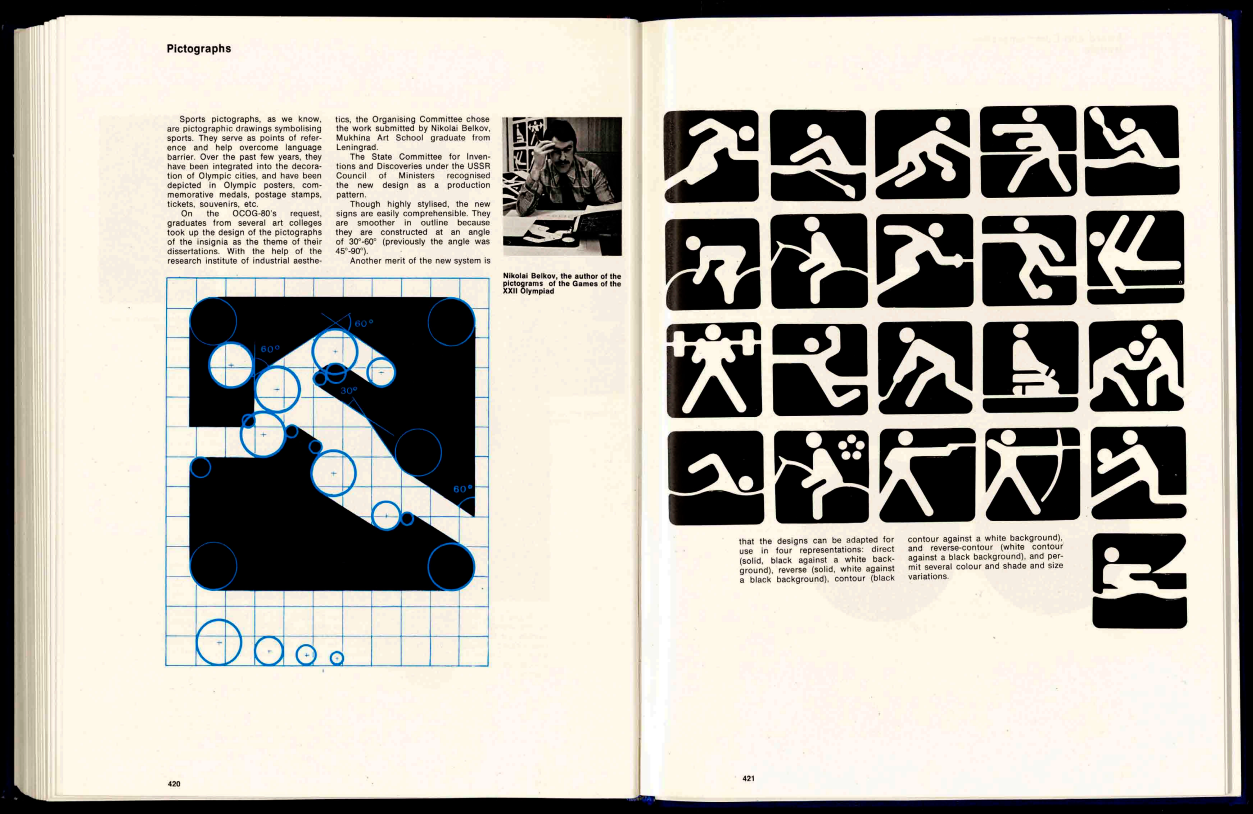
These image are not taken from the original style guide as it’s not available online but rather a book documenting the entire Olympics (scroll to page 9).
Next
Year: 1986, Author: Paul Rand
In 1986, Steve Jobs recruited renowned graphic designer Paul Rand to create a brand identity for Next – his ambitious venture after leaving Apple. The cost? $100,000 or an equivalent of roughly $250,000 today’s dollars. Next ultimately failed but the logo still remains somewhat iconic.
The original brand guidelines are hard to find but there is a simple logo spec sheet in the Paul Rand archive directory.
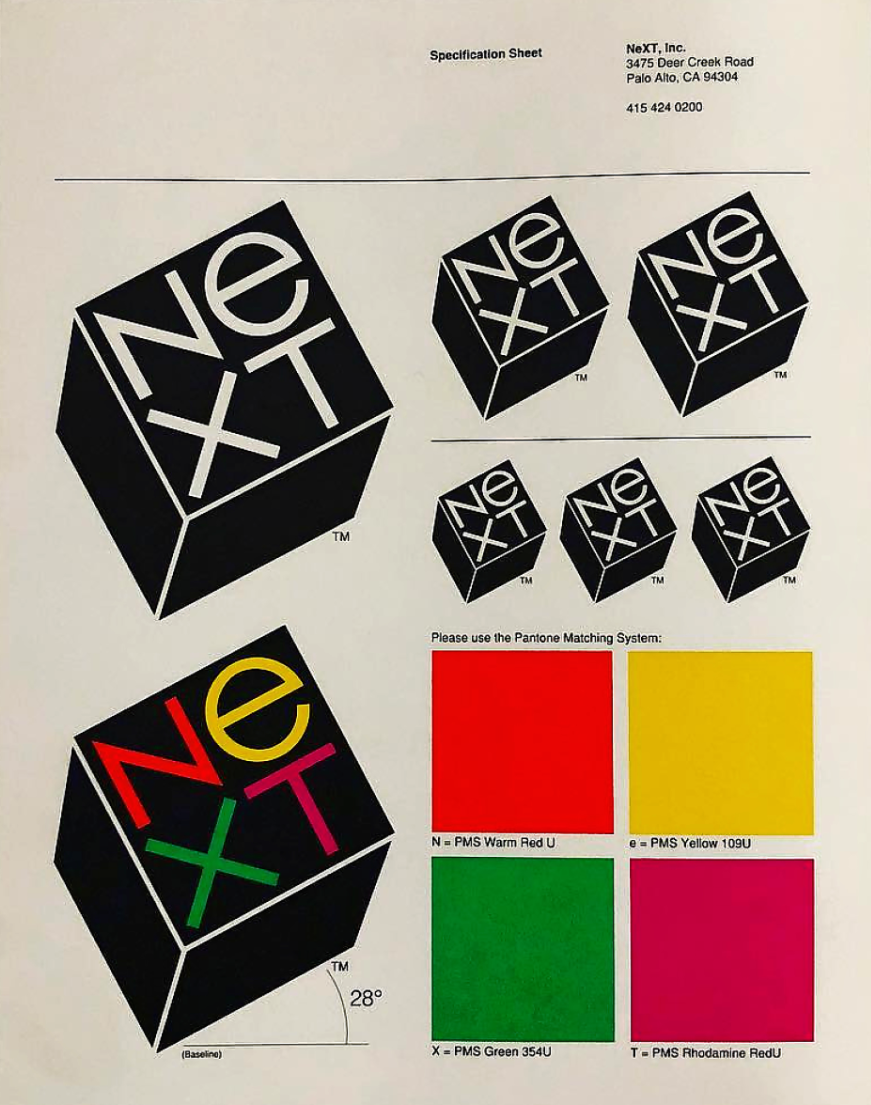
To persuade his clients that the proposed direction is indeed the right one Paul Rand produced a presentation book explaining his thought process. You should definitely go through it if you want to know more about his approach to graphic design and branding.
New York City Transit Authority
Year: 1970, Author: Massimo Vignelli and Bob Noorda, Unimark International
In 2013 someone found a copy of a first edition New York City Transit Authority Graphics Standards Manual in the basement of Pentagram‘s New York office. They decide to scan the entire book and make it accessible for all the other graphic design nerds. You can enjoy the high definition pdf here.

In case you would like to have a brand new copy in your living room you can buy it for $55.00.
Deutsche Bank
Year: 1978, Author: Anton Stankowski
A blue square with an oblique line, the company name written in simple sans serif font. Deutsche Bank’s logo is the epitome of modernist rationalism. Designed by Anton Stankowski it remains mostly unchanged to this day.
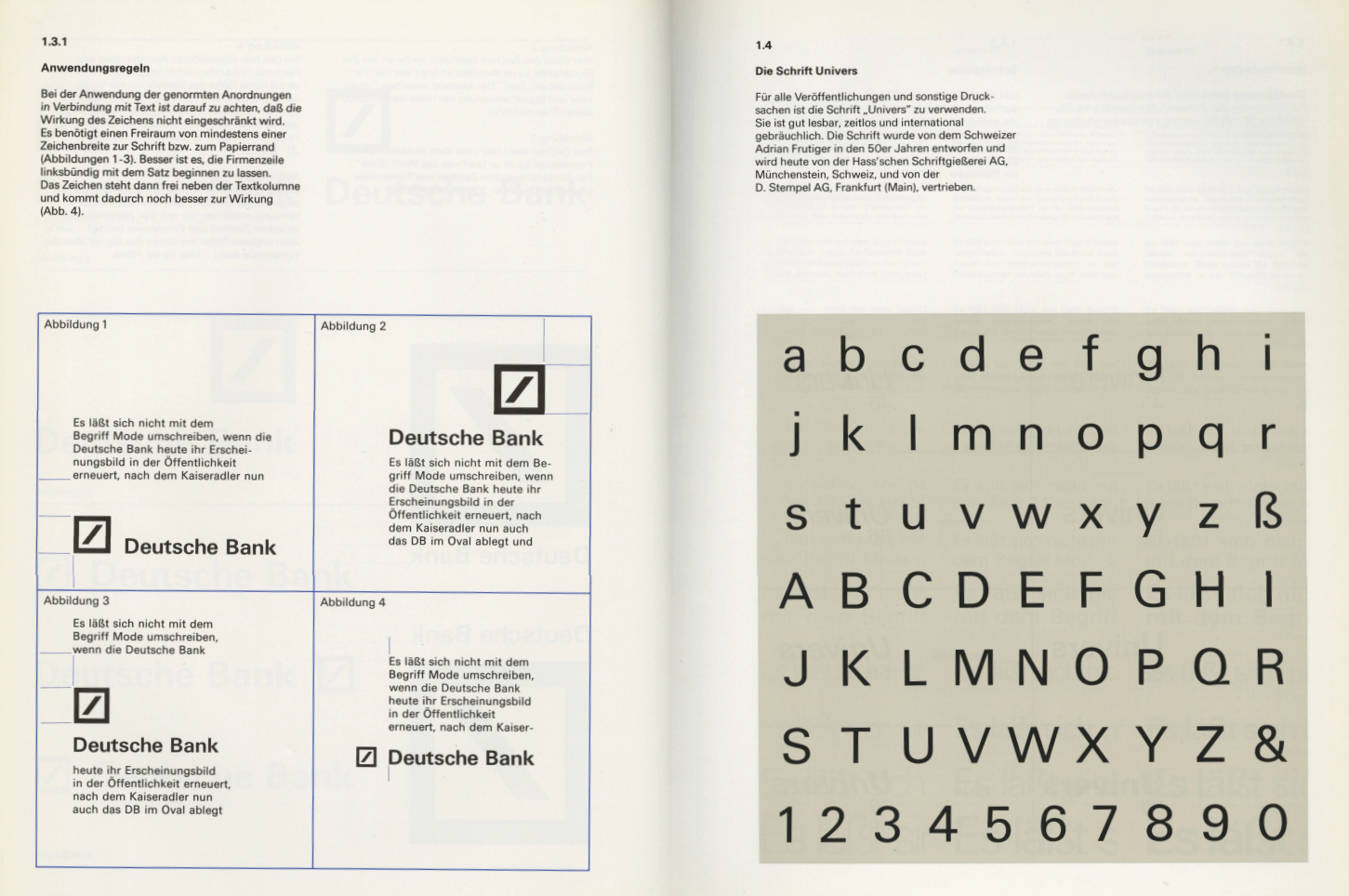
The brand manual however features much more diverse color palette than the dark blue we associate with Deutsche Bank today.
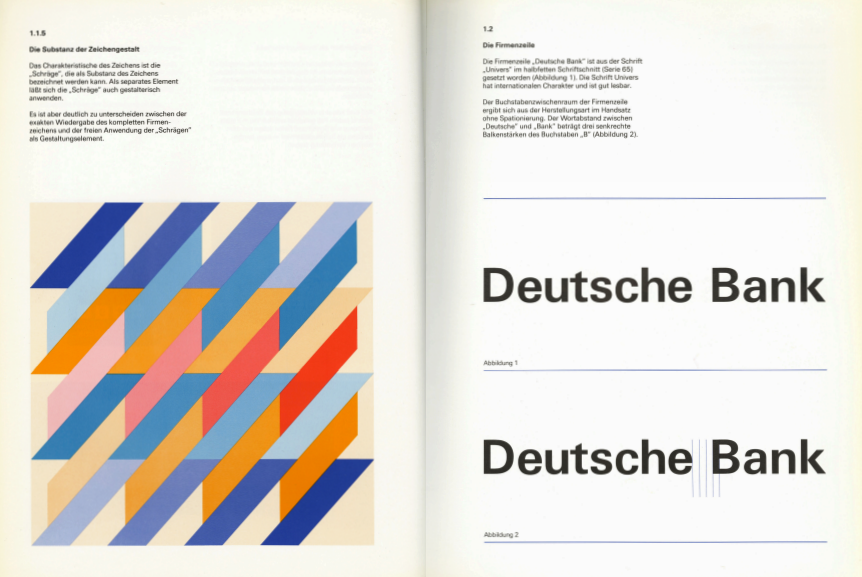
You can go through the full book online or learn more about the interesting history behind the Deutsche Bank brand.
IBM
Year: 1972, Author: Paul Rand
Paul Rand is probably most famous for his work on the “IBM Graphic Design Program”. The series of IBM logotypes created by Paul Rand culminated in 1972 in a drawn version made up of layered strips, making the company’s initials instantly recognisable all over the world.
The IBM graphic design guide is unfortunately nowhere to be found in a digital form but a nice Hardcover copy can be yours for $69.00.

The Dawn of Formalized Branding: The 1960s
The 1960s were a time of profound social change and a booming consumer culture. Brands were no longer just selling products; they were selling lifestyles, aspirations, and a sense of belonging. This growing understanding led to a greater need for consistency, and thus, the formal brand guideline was born.
One of the most celebrated examples from this era is the IBM Corporate Identity Manual. Introduced in the early 1960s, it was a masterpiece of design and clarity. Think clean lines, precise measurements, and an unwavering commitment to the IBM “pinstripe” logo. This manual wasn’t just about the logo; it dictated everything from typography and color palettes to photography style and even the way IBM employees should answer the phone. It was a comprehensive guide that aimed to create a unified and professional image for a global giant.
Imagine a graphic designer in 1965, tasked with creating an advertisement for IBM. They would pull out this heavy, bound manual. Flipping through its pages, they’d find exact specifications for the IBM logo’s dimensions, the acceptable colors (that classic IBM blue, of course!), and the approved typefaces. There would be examples of correct and incorrect logo usage – a clear declaration of what was on-brand and what was a no-go. This level of detail ensured that no matter who was creating marketing collateral, from New York to Tokyo, the IBM brand would look and feel the same. It was about building trust through unwavering visual coherence.
Another significant player was Mobil Oil. Their iconic Pegasus logo was already well-established, but the 1960s saw a push to standardize its application across their vast network of gas stations, advertising, and corporate materials. Their guidelines would have covered everything from the precise angle of the Pegasus wings to the font used on signage. This wasn’t just about aesthetics; it was about creating an instantly recognizable and trustworthy presence at every touchpoint. Think about the feeling of seeing that Pegasus, knowing you’re pulling into a reliable station. That consistency, meticulously documented, was key.
What’s fascinating about these early manuals is their tactile nature. They were physical objects, often beautifully printed with color swatches you could literally touch and compare. This hands-on approach fostered a deeper understanding and respect for the brand’s visual identity. In today’s digital world, we often click and scroll, but back then, designers and marketers held these documents, absorbed the details, and internalized the brand’s essence.
The Era of Boldness and Expansion: The 1970s
The 1970s brought a different energy. While professionalism remained important, there was also a growing embrace of bolder aesthetics, a move towards more expressive typography, and a recognition that brands needed to connect with consumers on an emotional level.
Consider the ABC Television Network in the 1970s. Their iconic circular logo, often depicted with a vibrant color gradient, was a symbol of their presence in households across America. Their brand guidelines would have been crucial for ensuring that this dynamic logo was reproduced accurately across countless on-air graphics, print ads, and promotional materials. Imagine the challenge of maintaining color fidelity across different printing processes and broadcast technologies of the time. The manual would have been their bible, specifying not just the logo’s form but also its exact color values, its minimum size, and how it should interact with other graphic elements.
Think about how many times you saw that ABC logo on your TV screen. Each instance needed to feel authentic. If a designer got the colors wrong on a print ad, or scaled the logo incorrectly on a billboard, it could dilute that powerful brand recognition. The 70s guidelines would have been the guardians of that consistency, ensuring the brand’s lively and engaging personality shone through.
Another strong example is the evolution of the Pepsi brand during this period. While Pepsi had its iconic red, white, and blue, the 70s saw them experimenting with more dynamic visual language. Their brand guidelines would have detailed how to use the “Pepsi Globe” in various contexts, ensuring its vibrant energy was consistently communicated. This included specifying the exact curvature of the globe, the placement of the wordmark, and the nuances of the color palette. For a brand competing in the fast-paced beverage market, maintaining a sharp and appealing visual identity was paramount.
The 70s also saw a rise in the use of photographic styles. Brand guidelines from this decade might have included sections on recommended photography, specifying themes, moods, and even the types of models or settings that were on-brand. This was a move beyond just logos and typography to encompass the entire visual narrative of a brand.
It’s also worth noting the influence of pop art and graphic design trends on these manuals. While still formal, some 70s guidelines might have exhibited a bit more flair, a touch more experimentation, reflecting the era’s creative spirit. However, the core principle of ensuring consistent application remained.
The Age of Personal Computers and Global Brands: The 1980s
The 1980s were characterized by economic growth, the rise of personal computing, and an increasingly globalized marketplace. Brands became more sophisticated in their marketing efforts, and the need for detailed, comprehensive brand guidelines became even more critical.
One of the most influential examples from this era is the Apple Macintosh Style Guide. While Apple’s aesthetic has evolved dramatically, the 80s saw the genesis of its clean, user-friendly design philosophy. Their internal guidelines would have been instrumental in defining the look and feel of early Macintosh hardware, software interfaces, and marketing materials. Imagine the challenge of translating a revolutionary product like the Macintosh into a consistent brand experience across all touchpoints. The style guide would have dictated everything from the spacing of text on screen to the design of the iconic “smiley face” logo’s applications.
Think about the original Macintosh ads. They were often minimalist, focused on the product’s innovation and ease of use. This clarity of message and visual execution was a direct result of strict adherence to internal branding principles. The 80s guidelines ensured that the Apple brand felt sophisticated, innovative, and approachable.
Another fantastic example is the AT&T Brand Identity System. AT&T was a behemoth, and its “Corporate Bell” logo was globally recognized. The 80s saw AT&T invest heavily in consolidating its brand across its diverse business units. Their brand guidelines were incredibly detailed, covering not just the logo’s placement and color but also the application of its distinctive bell shape as a graphic element. They even had guidelines for the sound of AT&T’s ringtone! This level of detail demonstrates a profound understanding that branding extended beyond the visual to encompass the entire customer experience.
The 80s also saw the emergence of more complex logo systems, with parent companies and their subsidiaries needing clear hierarchies. Brand manuals from this period would have addressed how to manage sub-brands and ensure a consistent overarching identity.
The advent of early desktop publishing software meant that designers had more tools at their disposal, but also more potential for inconsistency. Thus, the 80s brand guidelines became even more prescriptive, providing detailed rules for typography, layout, and photographic treatments to maintain control in this evolving landscape.
The Enduring Legacy of Analog Guidelines
Looking back at these iconic brand guidelines from the 60s, 70s, and 80s, we can see the fundamental principles that still underpin strong branding today.
Consistency is King: The primary goal was always to ensure a consistent visual presentation of the brand across all platforms and communications. This builds recognition, trust, and professionalism.
Detail Matters: These manuals were incredibly detailed, specifying everything from logo proportions and color values to typography and layout. Every element was considered.
Brand as an Experience: Beyond just visual elements, some guidelines started to encompass the broader brand experience, including photography, tone of voice, and even sound.
Guardians of Identity: These documents served as the ultimate reference point, the “source of truth” for anyone creating brand materials. They were the guardians of the brand’s visual identity.
These analog documents, though perhaps less sophisticated in their delivery mechanisms than today’s digital platforms, laid the groundwork for robust brand management. They taught us the importance of a defined visual language and the discipline required to maintain it.
From Print to Pixels: The Evolution of Brand Asset Management
While we can appreciate the craftsmanship of those old manuals, managing brand assets today is a vastly different endeavor. The explosion of digital channels, the speed of content creation, and the global reach of brands necessitate more dynamic and accessible solutions. This is where modern brand asset management comes into play.
Think about the challenges of distributing and updating a physical manual to thousands of employees and external partners worldwide. It was a logistical nightmare! Today, a centralized platform can host all your brand guidelines, logos, templates, and other assets, making them instantly accessible to anyone who needs them, anywhere in the world. This streamlines workflows, improves collaboration, and ensures everyone is working with the most up-to-date brand assets.
The principles of brand consistency tips remain paramount, but the methods of achieving them have evolved. Instead of a heavy binder, you have a digital repository. Instead of relying on individuals to meticulously follow print specifications, you can have digital checks and balances.
The transition from analog to digital has also enabled more sophisticated brand governance. Understanding what is brand governance is crucial for ensuring that your brand is used consistently and effectively across your organization. Modern platforms facilitate this by providing audit trails, version control, and clear access permissions. This ensures that everyone understands their role in brand stewardship and adheres to the established guidelines.
Furthermore, the ability to easily access and utilize brand assets has a direct impact on efficiency. Imagine the time saved when a marketing team can quickly find approved logos, images, and templates for their latest campaign, rather than having to track them down or recreate them. This is a core benefit of modern digital asset management workflow.
The Digital Revolution and Brandkity’s Role
At Brandkity, we understand this evolution deeply. We’ve taken the fundamental principles of those iconic 60s, 70s, and 80s brand manuals and translated them into a powerful, intuitive platform. We believe that managing your brand should be as seamless as using your brand’s products.
Our platform empowers organizations to:
Centralize Brand Assets: Store logos, images, videos, templates, and brand guidelines all in one accessible location.
Ensure Brand Consistency: Provide easy access to approved assets and clear usage guidelines, reducing the risk of off-brand materials.
Streamline Collaboration: Facilitate sharing and approval processes for brand assets, improving efficiency for internal teams and external agencies.
Enhance Brand Governance: Implement controls and permissions to ensure proper brand usage across the organization.
Just as the IBM manual of the 60s provided a clear blueprint for its visual identity, Brandkity provides a modern, dynamic solution for managing and deploying your brand’s identity in today’s fast-paced digital world. We help you avoid the pitfalls of inconsistent branding and ensure your message resonates clearly and powerfully with your audience.
Looking Ahead: The Future of Brand Guidelines
While we celebrate the past, the world of branding continues to evolve. Artificial intelligence is starting to play a role in asset creation and even in monitoring brand compliance. The lines between different forms of media are blurring, and brands need to be adaptable and agile.
The core message, however, remains the same: a strong, consistent brand identity is a powerful asset. The principles laid down in those early, tangible brand manuals are timeless. They remind us of the discipline, the foresight, and the dedication required to build a brand that endures. By learning from the past and embracing the tools of the present, we can continue to build iconic brands that stand the test of time.
So, as you navigate the complexities of branding today, take a moment to appreciate the pioneers who first formalized these essential practices. Their commitment to clarity and consistency laid the foundation for the sophisticated branding strategies we employ now. And remember, maintaining that consistency, no matter how large or small your organization, is one of the most crucial steps to building a truly memorable and impactful brand.
Saurabh Kumar
Founder, BrandKity
Saurabh writes about practical brand systems, faster client handoffs, and scalable workflows for designers and agencies building repeatable delivery operations.
Connect on LinkedIn